

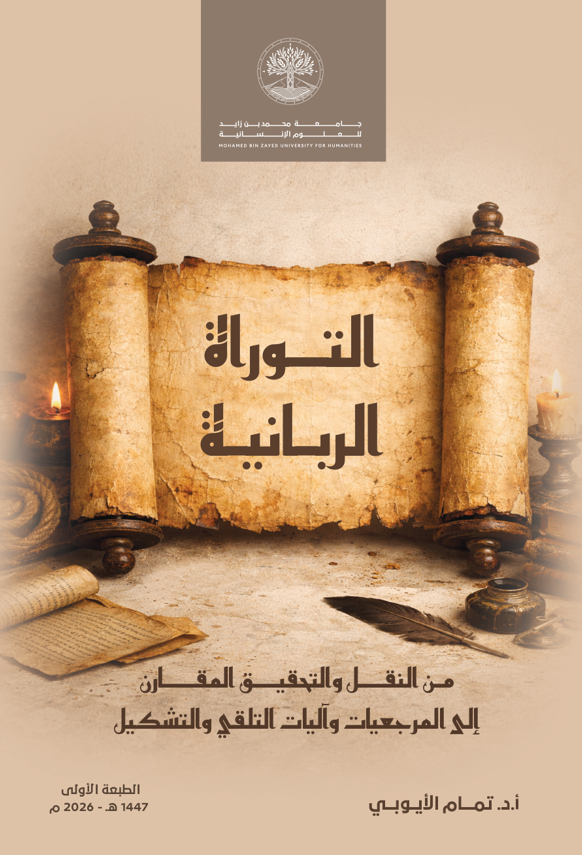
This book examines the Rabbinic Torah as an interactive intellectual product that extends beyond mere transmission from Hebrew into Arabic. Rather, it embodies a civilisational moment in which the spirit of two languages converged and two religious traditions coexisted within a single epistemic space through the incorporation of multiple cultural contexts and frames of reference. It traces the journey of the Pentateuch (the first five books of the Torah) from its Hebrew source, then its Aramaic form, and finally to its Arabic-Jewish structure as fashioned by the rabbi Saadia al-Fayyumi in a style that combines philological precision with interpretive openness. Drawing on authentic rabbinic manuscripts that have been critically edited and compared with scholarly and methodological rigour, the book thus establishes a pivotal stage in the formation of the Arabic-Jewish text.
This work represents an extension of a cross-religious cultural project and reaches far beyond translation alone. Within it, Islamic and Jewish religious reference points converge with Arabic, Aramaic, and Semitic linguistic sources, thus reshaping the sacred through the interaction of its written and oral forms. In doing so, it reveals the possibilities of deep intercultural exchange, with all the voices, dialects, and interpretations that this entails. The book also reconstructs the text on the basis of foundational primary rabbinic manuscripts that have not been altered or modified in either their Aramaic or Arabic-Jewish form, accompanied by meticulous critical editing that reveals the modes of reception in works of heritage and exegesis, as well as the strategies of translation and textual reconfiguration.
This is a book that does not simply recover a text. It illuminates an entire civilisational structure, offers a model for intellectual and religious understanding and mutual recognition, and opens a horizon for research into the intersection of languages with the sacred, at a time when we are in greatest need of renewing this kind of creative epistemic dialogue.